How the Venice Canals Were Built — and How Six of Them Survived
Venice began as an act of excavation. Before there were lots to sell or a pier to visit, there were crews cutting waterways out of coastal marshland south of Santa Monica, building the place Abbot Kinney intended to call Venice of America. The resort opened on July 4, 1905, and its defining feature was not the beach. It was the water inland from the beach: canals, a grand lagoon, gondolas and gondoliers brought in from Venice, Italy, and a miniature steam railroad running around the park. Kinney was selling a proposition as much as a place — that a new American city could be patterned, deliberately, on an old Italian one.
Digging a city out of marshland
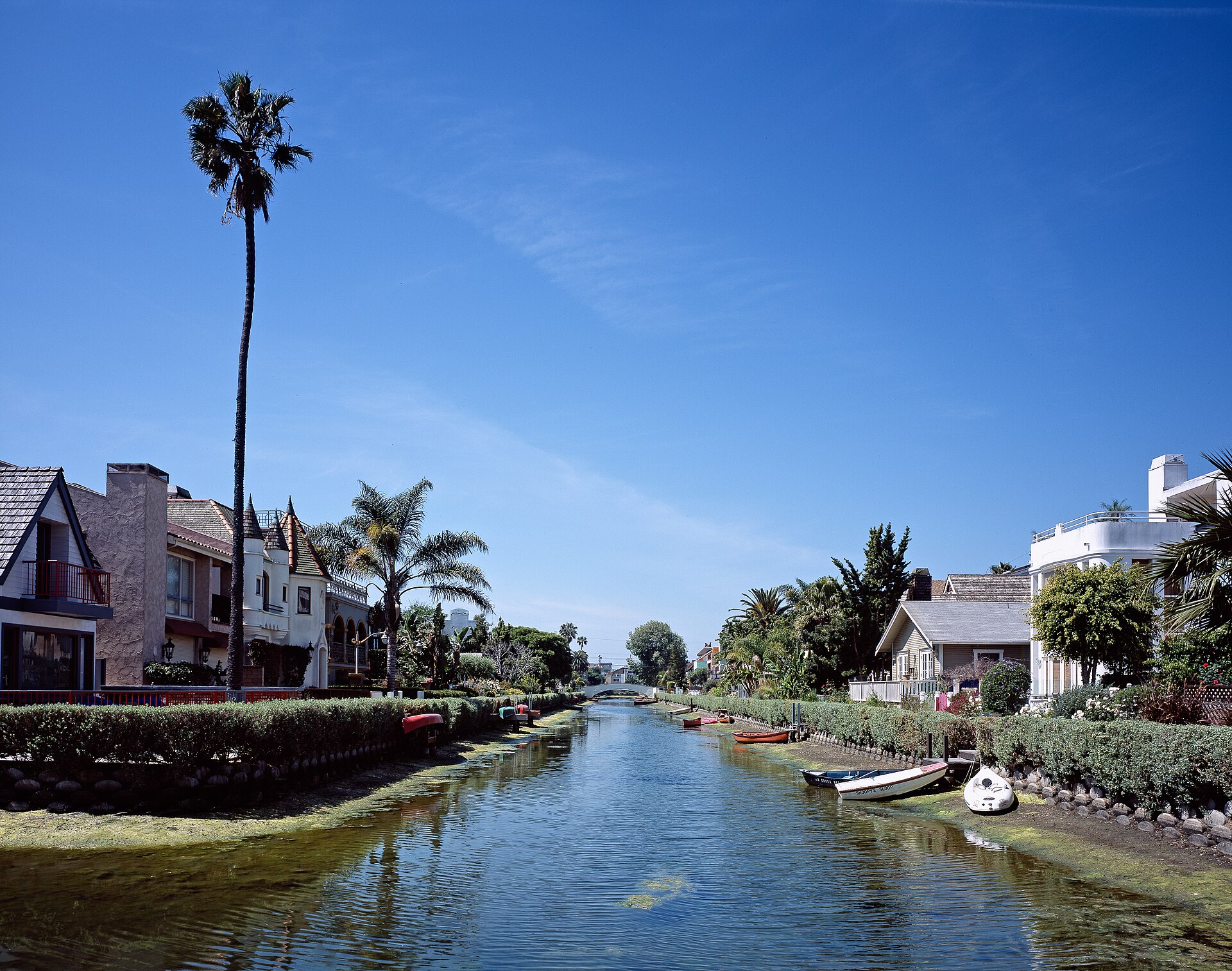
The canal system gave the resort its street plan, its scenery and its sales pitch. Lit canals and arched bridges drew widespread publicity and helped sell lots in the development. The names Kinney gave his canals — Aldebaran, Altair, Cabrillo, Coral, Grand, Lion and Venus — show the ambition plainly: this was to be a complete, composed landscape, not an ordinary beach subdivision. South of Kinney's own tract, another canal subdivision followed. Recorded in 1905, the Short Line Beach development laid out four parallel canals, Carroll, Linnie, Howland and Sherman, running toward Grand Canal, with single-family houses on the canal-fronting lots. It is that southern system, mostly, that a visitor can still walk today.
The lagoon beneath the circle
At the centre of the original resort sat the Grand Lagoon, around which the amusement district was arranged. Nothing of it remains as water. The traffic circle at Pacific and Windward Avenues — the circle beneath the Venice Sign, at the commercial heart of modern Venice — is located on top of what once was the lagoon. It is the single most useful fact for understanding the neighbourhood's geography: the roundabout that cars now circle was once the open water around which Kinney's Venice turned, and the streets radiating from it follow the lines of a resort that has otherwise largely vanished.
1929: the year the canals became streets
The canals' decline had several causes that compounded one another. Venice became part of the city of Los Angeles in October 1925. The surviving system came under sharp scrutiny from the health department, because a lack of circulation left the water turbid and malodorous. Cars, meanwhile, were gaining popularity quickly, and by the 1920s many residents viewed the canals as outdated. After a protracted three-year court battle, the bulk of the canals were paved over in 1929. Before 1929, the area covered by canals was roughly three to four times as large as it is today; the number of canals was reduced from thirteen to six. Seven of Kinney's canals survive only as street names: Main Street and Canal Street follow the Coral Canal, Cabrillo Avenue the Cabrillo Canal, San Juan Avenue the Venus Canal, Windward Avenue the Lion Canal, Altair Street the Altair Canal, Market Street the Aldebaran Canal, and Grand Boulevard the line of the Grand Canal.
The six that remain
The surviving district holds four east-west canals — Carroll, Linnie, Howland and Sherman — and two north-south canals, Eastern and Grand. By 1940 those remaining canals had fallen into disrepair and the sidewalks were condemned by the city. The district then stayed in poor condition for more than forty years, while proposals to renovate it failed over funding, environmental concerns and disputes about who should pay. Recognition came before restoration: the residential district around the remaining canals was listed on the National Register of Historic Places in 1982 and designated a Los Angeles Historic-Cultural Monument in 1983. The canals were finally renovated in 1992 — drained, with new sidewalks and walls built — and reopened in 1993. Water still moves through them on a tidal rhythm, entering through sea gates via the Ballona Lagoon; the gates open at low tide to drain most of the water and close at high tide, trapping it for about three days before it is refreshed again. What Kinney built as a sales device has become, a century on, a working piece of the coast that happens to have houses along it.